

Published April 22, 2026 · Last updated: April 22, 2026
Medspa Website Design in 2026: What High-Converting Aesthetic Practices Actually Build

The medspa website that consistently converts high-ticket consultations does two jobs at once: it earns patient trust on first impression, and it gets cited by AI systems before a patient ever visits your URL. Most aesthetic practices optimize for one and ignore the other entirely. The six design decisions in this guide address both simultaneously.
I've built brand identities and websites for aesthetic practices across the country. The pattern I see most reliably is a beautifully designed site that loads slowly, has no structured data, and buries the booking path three clicks deep. It looks impressive. It books almost nothing.
- The central tension in medspa web design is clinical credibility vs. luxury appeal; practices winning in 2026 hold both simultaneously
- Sites using real patient before-and-after results in the hero see 38% higher booking rates than lifestyle photography[1]
- Page speed directly affects AI citation rates; pages loading over 1.1 seconds earn 66% fewer citations than fast pages[2]
- Treatment page structure, FAQPage schema, and entity relationships determine whether ChatGPT and Perplexity recommend your practice
- Platform choice is near-permanent; Webflow serves luxury service practices best, Squarespace works with strict discipline
The Design Trap Most Aesthetic Practices Fall Into: Clinical or Luxury, Never Both
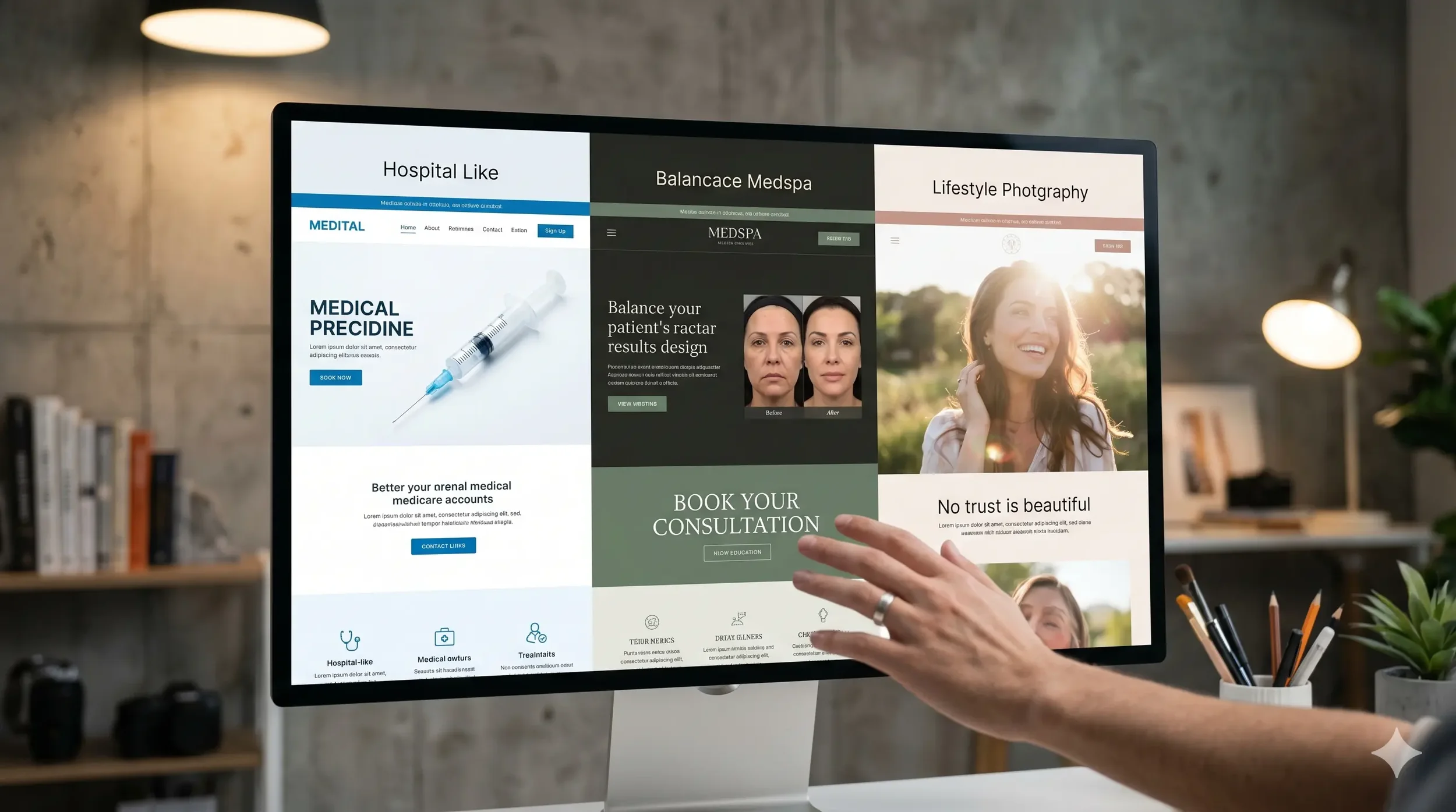
There is a design trap that catches most aesthetic practices. The practice either goes full clinical, white walls and stock photos of syringes, or full luxury, lush lifestyle photography and aspirational copy with no medical substance underneath. Both extremes fail for different reasons.[3]
The clinical website repels the client who wants to feel pampered, not processed. The luxury website fails to signal the medical credibility a patient needs before trusting someone with their face. The practices dominating their markets in 2026 have solved this tension. Their websites feel simultaneously like a high-end spa and a serious medical practice.
Solving that tension is not a design trick. It is a series of deliberate decisions about what to show, how to show it, and in what order. The practices that have figured it out are booked three months in advance. The ones that have not are still running discounts to fill the calendar.
The difference is not budget. It is not which designer you hired. It is whether your website makes a $1,200-per-visit client feel confident before they ever speak to a human.
Six Design Decisions That Separate Booked-Out Aesthetic Practices From Everyone Else
These are not aesthetic preferences. They are conversion decisions with measurable effects. Each one addresses a specific question your prospective patient is trying to answer without having to ask.
Decision 1: Lead with real patient results, not lifestyle photography. Sites using real before-and-after results in the hero section see 38% higher booking rates than those using lifestyle photography.[1] The patient landing on your Botox page is not wondering what your waiting room looks like. They are wondering whether they will look natural. Show them the answer immediately. Pair the result with the provider's name and a visible "results may vary" disclosure near the image.
Decision 2: Make your provider visible and credentialed before the fold. Patients research injectors. They make decisions based on who is performing the treatment, not just where. Provider bios with credentials, certifications, and professional headshots placed near the top of the homepage, not buried in an About page, remove the primary anxiety a patient carries before booking.
Decision 3: Eliminate booking friction within two taps on mobile. The booking button should be accessible from the homepage hero, from every treatment page, and from every point in the mobile navigation. A patient who decides at 11 PM that they want a consultation should be able to book in under 60 seconds.
Decision 4: Build for sub-second load time on mobile. Page speed is a direct AI citation factor. Pages loading over 1.1 seconds earn an average of 2.1 AI citations compared to 6.7 for fast pages.[2] Speed is not a nice-to-have. It is a discovery prerequisite.
Decision 5: Structure treatment pages as knowledge assets, not service brochures. A 200-word Botox page competes against a 1,500-word page covering candidacy, expected results, recovery, pricing context, and patient FAQs. The deeper page ranks higher, earns more AI citations, and converts more confidently because it answers the questions a patient would otherwise need to call to ask.
Decision 6: Build the AI architecture layer into the site from the start. FAQPage schema on every treatment page. Organization schema on the homepage. Provider Person schema on bio pages. Treatment-level entity relationships connecting your practice to the specific services you offer. These are the technical signals that determine whether ChatGPT and Perplexity can retrieve and recommend your practice.
Ready to see what a high-converting medspa website looks like in practice?
See Our Aesthetic Practice Portfolio →Platform Reality: Webflow vs. Squarespace vs. WordPress for Aesthetic Practices
The platform question is permanent in a way most practice owners underestimate until three years in. I have built on all three. Here is the honest framework.
Webflow is the right choice for luxury service aesthetic practices with budgets over $10,000 and no product sales. The output code is clean, loads fast, and is AI-indexable with minimal extra configuration. Design control is complete. The tradeoff is a higher initial cost and an editing interface with a short learning curve.
Squarespace is where I see the most medspa owners make the wrong call. It works well for simple portfolios and early-stage practices. For a luxury aesthetic brand trying to convert $500-per-session clients, Squarespace's template-first approach creates a visual ceiling. The templates were designed primarily for hospitality businesses. They look polished. They do not look premium in the way high-ticket aesthetics requires. Squarespace also loads slowly once heavy images and third-party embeds accumulate.
WordPress is the right call for content-heavy practices, multi-provider groups, or practices needing deep customization, membership portals, or complex integrations.
My rule of thumb: luxury service practice, no product sales, budget over $10K equals Webflow. Product component equals Shopify. Content and flexibility priority equals WordPress with a strong developer. Early stage or budget-constrained equals Squarespace with strict discipline.
Medspa Website Audit: The 6-Decision Checklist
Click each item to mark it complete and see where your site stands.
-
1Real before/after results in hero section Not lifestyle photography. Real result, credited provider, visible disclaimer.
-
2Provider credentials visible above the fold Name, credential, headshot on homepage. Not buried in a submenu.
-
3Booking reachable in 2 taps on mobile Test it right now. Homepage to booking confirmed in under 60 seconds.
-
4Page speed: FCP under 1.0 second Test at pagespeed.web.dev on mobile. Over 1.1s = 66% fewer AI citations.
-
5Treatment pages: 1,200+ words with candidacy, recovery, FAQs Check your top 3 treatment pages. Are they answering pre-booking questions?
-
6AI architecture: FAQPage schema on treatment pages Test via Google Rich Results Test. No schema = ChatGPT cannot retrieve your Q&As.
0 of 6 complete
AI Search Architecture: What Your Medspa Website Needs to Get Cited by ChatGPT
AI systems do not rank pages. They retrieve structured knowledge from sources they can understand and trust. Most medspa websites were not built for retrieval. They were built for humans.
Your beautifully written Botox page, if it lacks structured data and entity relationships, is effectively invisible to ChatGPT. Your patient testimonials, if not wrapped in machine-readable schema, cannot be surfaced by Perplexity. This is not a content problem. It is an architecture problem.
Three specific decisions make the difference. First, add FAQPage schema to every treatment page. AI systems pull Q&A pairs directly to construct answers when patients ask what Morpheus8 recovery looks like or who is a candidate for lip filler. Your treatment page Q&As, marked with FAQPage schema, become the source that gets cited.
Second, add MedicalBusiness and Organization schema to the homepage. AI systems cross-reference your practice's claimed services, credentials, and location data. If your schema is absent or inconsistent, the AI's confidence in recommending you drops. Claiming and verifying your Bing Places listing matters for the same reason: ChatGPT uses Bing's index, and an unverified practice is an invisible one.
Third, structure treatment pages to name specific entities: brand names like Botox, Juvederm, Morpheus8, and CoolSculpting; procedure categories; provider credentials by name. Named entities increase AI citation probability because AI systems use entity density as a trust signal.
The Before-and-After Photography Strategy That Actually Increases Bookings
The 38% booking rate lift from real patient results in the hero is significant, but implementation matters as much as the decision to implement it.
The most effective before-and-after content in 2026 is not a gallery buried in a submenu. It is a subtle, natural-looking result placed in the hero section, credited to a named provider, with a visible "results may vary" disclosure and patient consent statement near the image. That combination answers the patient's primary question immediately, establishes provider credibility, and signals that your practice operates with medical professionalism.
What does not work: dramatic transformations that look more like advertising than reality, stock images with no patient attribution, or results framed as typical outcomes without disclosure. Those approaches erode trust at the exact moment they should be building it.
The before-and-after strategy that converts high-ticket patients uses real people, real providers, real results, and real transparency about what those results represent and who produced them.
References
- PxlPeak. 10 Best Med Spa Website Designs 2026. February 26, 2026. pxlpeak.com
- SE Ranking. What Makes Websites Get Cited by AI: Analysis of 129,000 Domains. 2025. [VERIFY URL at seranking.com before publish]
- ReporterOutreach. Medical Spa SEO: How to Rank and Win AI Search in 2026. April 2026. reporteroutreach.com
- Pronk MedSpa Marketing. Med Spa AI Search Optimization. 2026. pronkmedspamarketing.com
Frequently Asked Questions About Medspa Website Design
The most common causes: the booking path requires too many clicks on mobile, the website does not answer the patient's primary question immediately, and the page loads slowly enough that patients abandon before the call to action. Test your mobile booking path from homepage to confirmed consultation. If it takes more than three taps, that is your first fix. Then check page speed at pagespeed.web.dev on the mobile test.
For a luxury aesthetic practice serious about conversion, the realistic investment range is $10,000 to $20,000 for a custom Webflow or advanced WordPress build with full AI search architecture, conversion optimization, treatment page depth, and professional photography integration. Template-based builds at $3,000 to $6,000 can look beautiful but typically lack the AI architecture layer. Results from any web design investment are individual and vary by practice, market, and execution.
At minimum: Organization schema on the homepage with name, address, telephone, services, and sameAs links to your social profiles and Bing Places listing; LocalBusiness schema for your physical location; BlogPosting schema on every blog post; MedicalBusiness schema on practice pages; FAQPage schema on every treatment page; and Person schema for every named provider. Test your implementation at search.google.com/test/rich-results. These are not optional if AI search visibility is a goal.
Start with Bing Places: ChatGPT uses Bing's index, and an unclaimed listing means you are invisible in ChatGPT local recommendations regardless of your Google ranking. Then add the schema layer described above. Then build treatment page depth with real Q&A content structured for FAQPage schema retrieval. Then earn editorial mentions from industry publications like AmSpa and Dermascope. AI citation likelihood compounds across all four signals together.
For a luxury service practice with no product sales and a budget over $10,000, Webflow gives the best combination of design control, performance, and AI search architecture capability. Squarespace works for early-stage practices or those on tighter budgets, but requires real discipline to avoid the performance and visual ceiling problems that come with its template-first approach. The right answer depends on your scale, revenue, and how seriously you plan to invest in content depth and AI visibility over the next three years.
Conclusion
The medspa websites converting patients consistently in 2026 were built to solve two problems simultaneously: they convert the patient who lands on them, and they earn citations from the AI systems that now influence how patients discover practices in the first place.
Six design decisions accomplish both. Leading with real patient results, making providers credentialed and visible, eliminating booking friction, building for mobile speed, writing treatment pages as knowledge assets, and embedding the AI architecture layer from the start. None of these require extraordinary budgets. All of them require deliberate priority over afterthought.
If your current medspa website is not producing the consultation volume your practice deserves, the gap is almost always in one or more of these six decisions. Finding and fixing the specific gap is faster than a full rebuild.
Find Out Exactly What Your Medspa Website Is Missing
Book a free 15-minute strategy call with Ambrose Marketing. We will audit your current site against these six decisions and tell you precisely what is holding your conversion rate back.
Book Your Free Strategy Call →The marketing strategies discussed in this post are for educational purposes. Results from implementing these strategies are individual and vary by practice, market, and execution. Consult a qualified healthcare marketing professional before making changes to your practice's marketing or website.
